

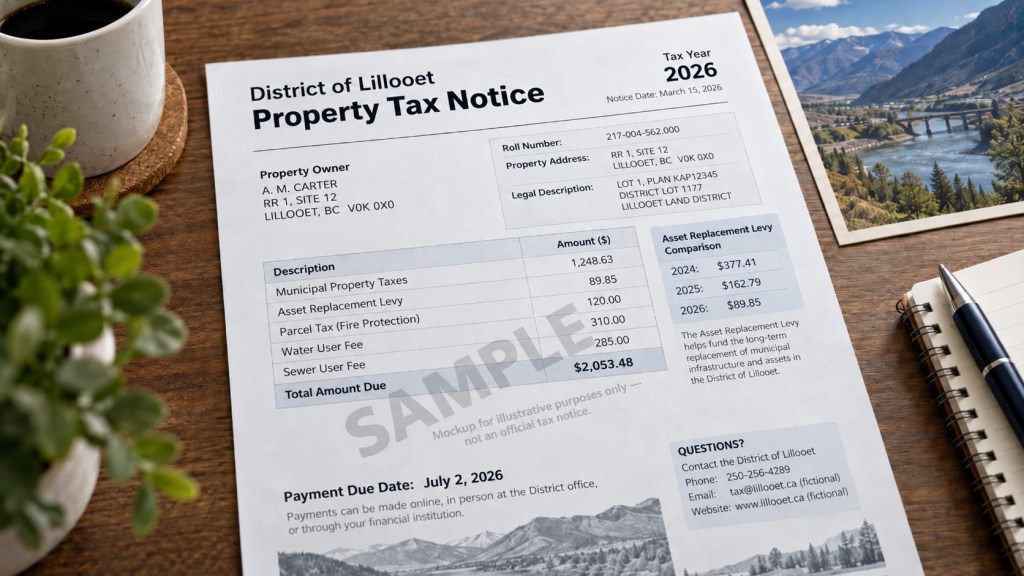
There’s a line on our property tax bill that needs a little more attention: Asset Replacement.
In 2024, we paid $377.41.
In 2025, we paid $162.79.
In 2026, another $89.85.
That’s $630.05 from one property in three years.
Now multiply that across the community.
The District of Lillooet confirms that this separate asset-replacement tax began in 2024, and says the money collected is put into reserves for the future replacement of District assets. Lillooet Property Taxes
Fair enough. Roads wear out. Pipes fail. Buildings age. Vehicles and equipment eventually need replacing. Municipalities absolutely should plan ahead for those costs.
But that brings me to the obvious question:
What exactly are we saving for?
A proper asset-management plan is more than simply putting money into a reserve account. Good municipal asset management identifies what assets the community owns, their condition, what needs repair or replacement, approximately when that work will be required, what it is expected to cost, and how it will be funded. B.C. guidance describes asset management as long-term planning for the construction, operation, maintenance, renewal and financing of infrastructure. Government of British Columbia
That is the piece I want residents to be able to see clearly.
The District does publish financial plans and says its budgeting process includes open meetings and public consultation. Financial Planning – Lillooet
It also has an Asset Replacement Financial Strategy specifically for the water system. Water Lillooet
What I have not found publicly is a clear, comprehensive District-wide asset-management plan connecting this separate levy to a list of assets, their condition, replacement priorities, expected costs and timelines.
That matters.
Because government does not have its own money. It is public money. Whether it comes through property taxes, fees, levies or grants, residents should be able to understand where it is going and what the plan is.
I’m not opposed to planning for infrastructure replacement. Quite the opposite. I want the planning to be strong enough that taxpayers can see why the money is being collected in the first place.
For me, good asset management should answer some very basic questions:
What do we own? What condition is it in? What needs replacing first? What will it cost? How much do we already have saved? And how much more actually needs to be collected?
Its not complicated.
Its okay to ask questions.
That’s transparency.


Leave a comment